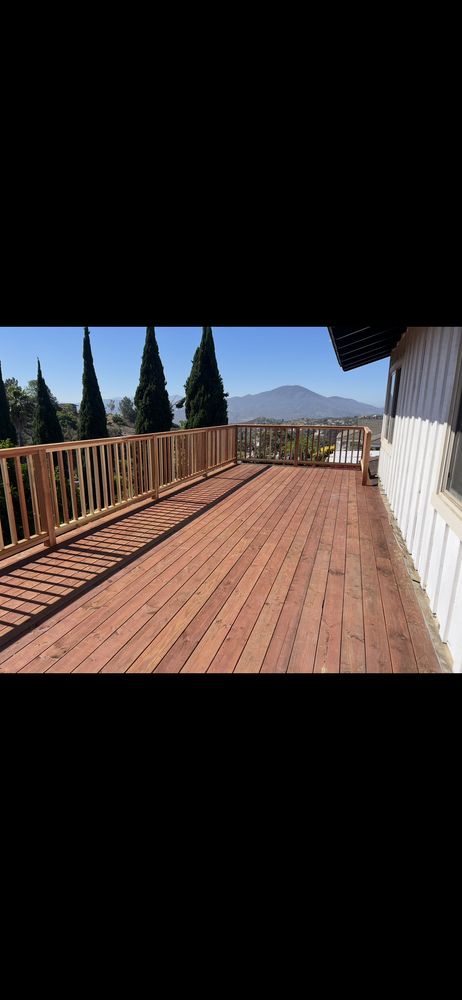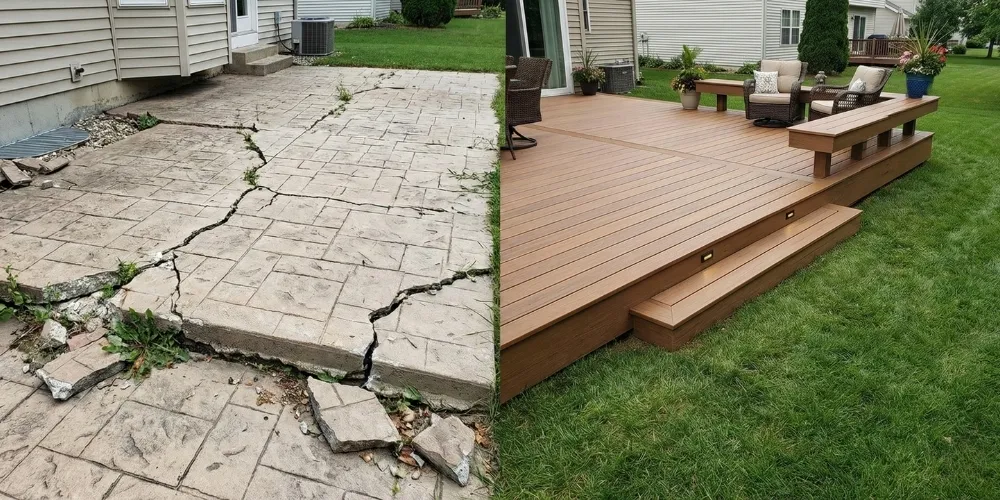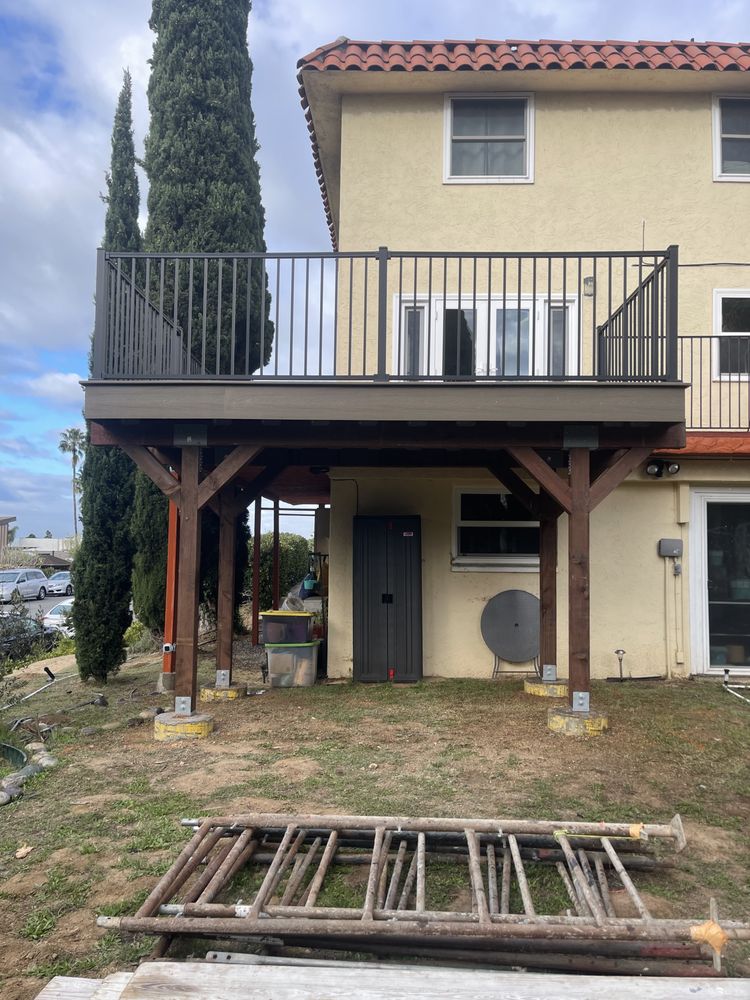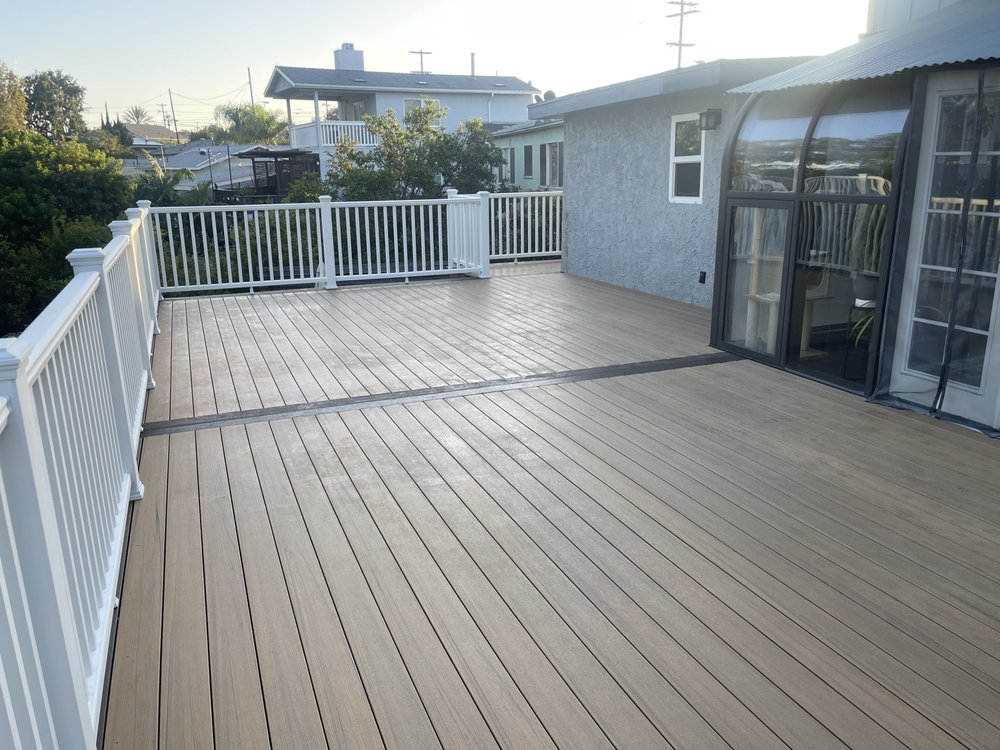
Building a new deck in San Diego costs $35 to $65 per square foot installed in 2026, with premium builds running $85 and up. For a standard 300-square-foot deck, that lands around $10,500 to $19,500, though canyon lots, tall framing and high-end materials push some projects past $25,000. The decking material and the height and complexity of the structure move the number more than anything else. This guide breaks down real 2026 pricing by size and material, shows where labor and materials split, and covers the San Diego factors that catch homeowners off guard.
Average Deck Cost by Size
Expect $35 to $65 per square foot installed for most San Diego decks. Price scales with square footage, but taller and multi-level decks cost more per foot because they need bigger footings, more framing and code-required railings. A small ground-level platform can run under $40 a foot, while a raised, multi-level build on a slope climbs past $85. Here is a realistic 2026 range for a mid-grade composite deck in San Diego:
| Deck size | Typical installed cost |
|---|---|
| 150 sq ft (small) | $6,000 – $12,000 |
| 300 sq ft (standard) | $9,000 – $21,000 |
| 500 sq ft (large) | $18,000 – $38,000 |
| Multi-level / elevated | $25,000 – $60,000+ |
Numbers assume a mid-range capped composite. Pressure-treated wood lands lower; IPE hardwood and premium multi-level builds land higher. A common San Diego project, a 12x16 (192 sq ft) composite deck two to three feet off the ground, runs about $8,000 to $13,000 all in. Want a figure for your exact size and material before you call anyone? Run the numbers through our deck cost calculator, then treat the result as a starting point rather than a final quote.
Cost by Decking Material
Material is the single biggest swing in your budget. Here is what each option runs per square foot for materials alone:
| Material | Cost / sq ft | Best for |
|---|---|---|
| Pressure-treated wood | $15 – $25 | Tight budgets |
| Composite (Trex, TimberTech) | $30 – $60 | Low maintenance |
| Redwood / cedar | $30 – $50 | Natural wood look |
| AZEK / PVC | $40 – $70 | Pools & coast |
| IPE hardwood | $40 – $70 | Longest lifespan |
The cheapest board is rarely the cheapest deck over time. Pressure-treated wood costs the least up front but lasts 15 to 25 years and needs staining or sealing every two to three years. Composite and PVC run 25 to 50 years with almost no upkeep, so the higher material price buys back years of labor and stain. Redwood and cedar sit in the middle: gorgeous, natural, and around 20 to 25 years with regular care. IPE hardwood is the toughest wood you can buy and can pass 40 years, which is why it carries a premium price. Not sure which fits your home and climate? Our guide to the best decking material for San Diego breaks down each option side by side.
Labor vs. Materials: Where the Money Goes
On a typical San Diego deck, materials run 40 to 60 percent of the total and labor covers the rest. Materials-only pricing sits at $15 to $25 per square foot for pressure-treated lumber, $30 to $60 for composite, $40 to $70 for PVC or AZEK, $30 to $50 for redwood or cedar, and $40 to $70 for IPE. Labor adds another $15 to $35 per square foot depending on framing height, railing style and how hard the site is to reach.
A ground-level 200-square-foot redwood deck on a flat Chula Vista backyard leans low because the crew frames it fast. A raised composite deck stepping down a Point Loma canyon lot carries far more labor for the posts, beams and deep piers that hold it off the slope. Same footage, very different bill.
What Drives the Price Up
Two decks of the same size can differ by $15,000. These are the line items that move the number:
- Height and elevation — a deck over 30 inches off the ground needs guardrails, taller posts and bigger footings. Second-story and rooftop decks can double the framing cost of a ground-level build.
- Demolition — tearing out an old deck adds $5 to $15 per square foot. Read our repair vs. replace guide before you assume the old one has to go.
- Railings — wood railing runs about $40 per linear foot, while cable and glass railing runs $70 to $200. On a 50-foot perimeter that swing alone is $1,500 to $8,000.
- Stairs — each flight adds $1,000 to $3,000, more when it turns or lands on grade you have to prep first.
- Site, soil and slope — hillside and canyon lots in Poway, La Jolla, Del Mar and Alpine need deeper piers and sometimes retaining work, adding thousands before a single board goes down.
- Permits and engineering — plan on $400 to $1,500 for the permit; elevated and hillside decks often need a stamped structural plan on top. See our San Diego deck permit guide.
San Diego-Specific Cost Factors
Building near the Pacific changes the math. Three local factors push San Diego deck budgets past the national average:
- Coastal corrosion — salt air in Coronado, La Jolla, Carlsbad, Encinitas and Point Loma eats standard fasteners and connectors. Stainless-steel hardware and hot-dipped hidden clips add a few hundred dollars but keep the frame from rusting out in a decade. PVC and AZEK boards shrug off salt better than wood.
- SB326 balcony law — California SB326 requires periodic inspection of elevated exterior elements on multi-family buildings. If you own a condo or apartment deck, budget for the inspection and any repairs it flags.
- HOA rules — many San Diego County communities set approved materials, colors, heights and railing styles. HOA review can add weeks and sometimes forces a pricier board, so confirm the guidelines before you sign anything.
New Build vs. Resurface or Deck-Over
If your framing and footings are sound, resurfacing costs far less than a full rebuild. A deck-over that swaps only the boards and railings runs $20 to $35 per square foot, roughly half the price of new construction, because you skip demolition, footings and framing. On a 300-square-foot deck that is about $6,000 to $10,500 instead of $10,500 to $19,500.
The catch is that a resurface only works when the substructure passes inspection. Rotted joists, undersized beams or corroded connectors mean you are paying to dress up a deck that will fail. We check the frame first through our deck replacement and inspection process, then tell you honestly whether a deck-over or a full rebuild is the smarter spend.
Permits, Inspections and SB326
Most San Diego decks need a permit, and we pull it for you. The permit itself runs $400 to $1,500 depending on size and value, and the plan check can take a few weeks. Elevated balconies and multi-family decks fall under California SB326 and need periodic inspection by a licensed professional, which we handle through our deck inspection service. Skipping the permit is a false savings: an unpermitted deck can block a home sale, void insurance after a failure and force a tear-out. Budget the permit into your total from the start so the final number holds.
Hidden Costs to Budget For
The board and labor price is not the whole story. Set aside 10 to 15 percent for the extras that show up on real projects:
- Permit and plan check — $400 to $1,500, plus $500 to $2,000 for structural engineering on hillside or elevated decks.
- Demolition and haul-off — $5 to $15 per square foot to remove and dispose of an old deck.
- Utility and grading conflicts — moving a gas line, AC unit or sprinkler, or leveling grade, can add $500 to $3,000.
- Upgraded hardware — stainless fasteners and connectors for coastal homes.
- Lighting and electrical — deck lighting and outlets run $500 to $2,500 installed.
- Finishing — stain and sealer on a wood deck cost $2 to $4 per square foot every few years.
How to Save Money Without Cutting Corners
There are honest ways to trim a deck budget and there are shortcuts that cost you later. Stick to these:
- Keep the shape simple — rectangles frame faster than curves, angles and multiple levels. A boxy deck can save 10 to 20 percent in labor.
- Stay under 30 inches where the yard allows, so you skip guardrails and heavier framing.
- Mix materials — run premium composite on the walking surface and wrap the substructure in pressure-treated framing, which no one sees.
- Reuse sound footings — a composite resurface over a solid frame skips the priciest labor.
- Build in the off-season — late fall and winter often bring better crew availability and pricing than the spring rush.
- Get an itemized quote so you can see exactly which upgrades cost what and drop the ones you do not need.
The corners not to cut: framing lumber grade, fastener quality on coastal jobs, and the permit. Saving a few hundred dollars there buys you a deck that sags, rusts or gets red-tagged.
Financing Your Deck
A $15,000 deck rarely comes out of checking all at once, and San Diego homeowners have a few ways to spread the cost. A home equity line of credit or home equity loan usually carries the lowest rate because your house secures it. Contractor financing offers fast approval and fixed monthly payments, sometimes with a promotional zero-interest window. A personal loan needs no equity but comes with higher rates and shorter terms. Whichever route you pick, get the full written scope first so the loan matches the real cost.
Return on Investment and Home Value
A new deck returns about 60 to 75 percent of its cost at resale in San Diego. Outdoor living is a strong selling point in a climate that supports it year-round, so a clean, permitted deck helps a home show better and move faster. A $12,000 composite deck that recovers 70 percent puts roughly $8,400 back into the sale price while you enjoy the space in the meantime.
Composite and PVC hold their return best because a buyer sees a 25-to-50-year surface with no maintenance ahead. A neglected, graying wood deck can read as a repair project and drag value down. Permits matter here too: unpermitted work often gets flagged during escrow. Build it right and keep the paperwork.
How to Get an Accurate Number
Online calculators give you a ballpark, but the only way to a firm price is an on-site measure. As a licensed deck builder in San Diego, we look at your access, soil, height and material, then hand you a written, itemized quote at no cost. Start with our deck installation service or just request a free estimate.
Quick Answers
How much does a 12x16 deck cost in San Diego?
A 12x16 (192 sq ft) deck runs about $7,000 to $13,000 installed for mid-grade composite, or $4,000 to $6,000 for pressure-treated wood. Height, railings and stairs move it within that range.
Is it cheaper to build a deck or a patio?
A patio is usually cheaper per square foot, but a deck adds more usable space on a sloped San Diego lot and often returns more at resale.
Is composite or wood cheaper for a deck?
Wood is cheaper up front at $15 to $50 per square foot for materials, versus $30 to $70 for composite. Over 25 years composite often wins because it needs no staining or sealing.
Do I need a permit to build a deck in San Diego?
Yes, most decks need a permit in San Diego County, especially those over 30 inches high or attached to the house. The permit runs $400 to $1,500, and we pull it for you.
Can I build a deck for under $10,000 in San Diego?
Yes, for a smaller or wood deck. A ground-level pressure-treated deck up to about 300 square feet, or a composite deck around 150 to 200 square feet, fits under $10,000. Height, stairs and premium boards push past it.
Does a new deck add home value?
Yes. A well-built deck commonly returns 60 to 75 percent of its cost at resale and makes a home easier to sell in the San Diego outdoor-living market.
Skip the estimates online. We measure and price your project for free.
Get a Free Estimate