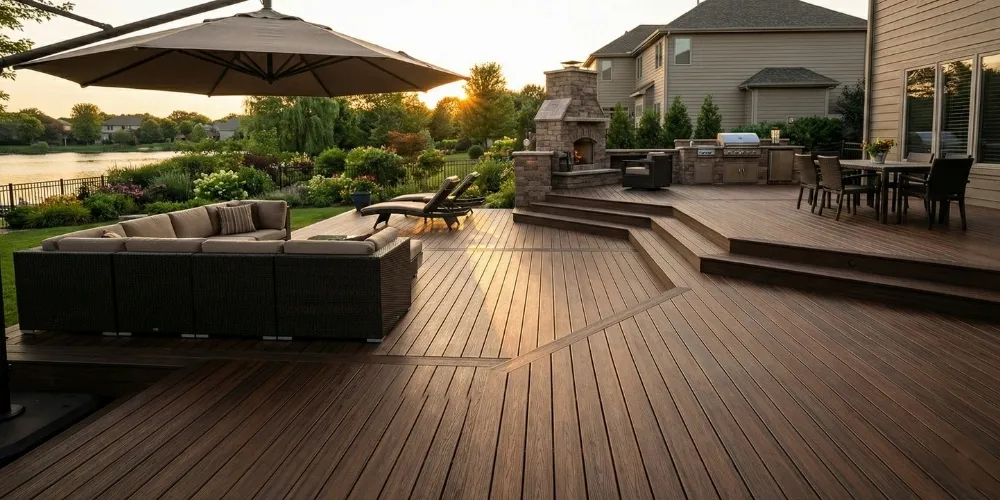
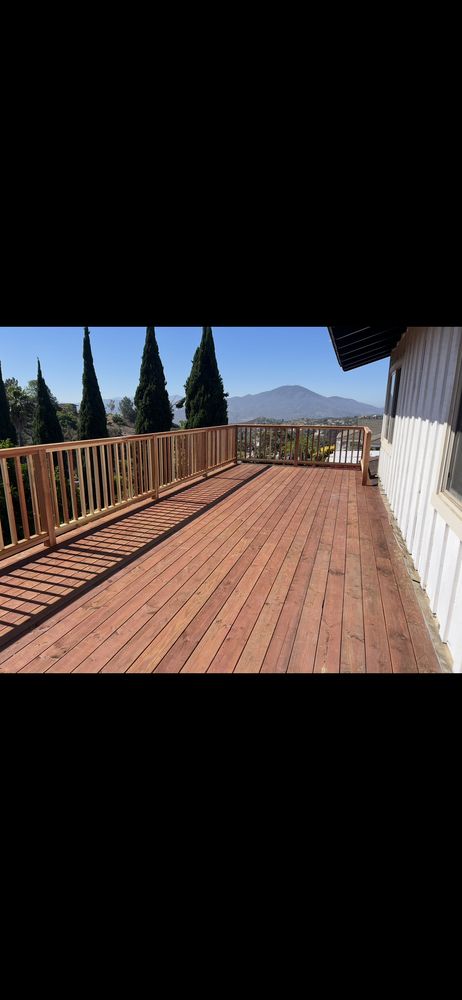
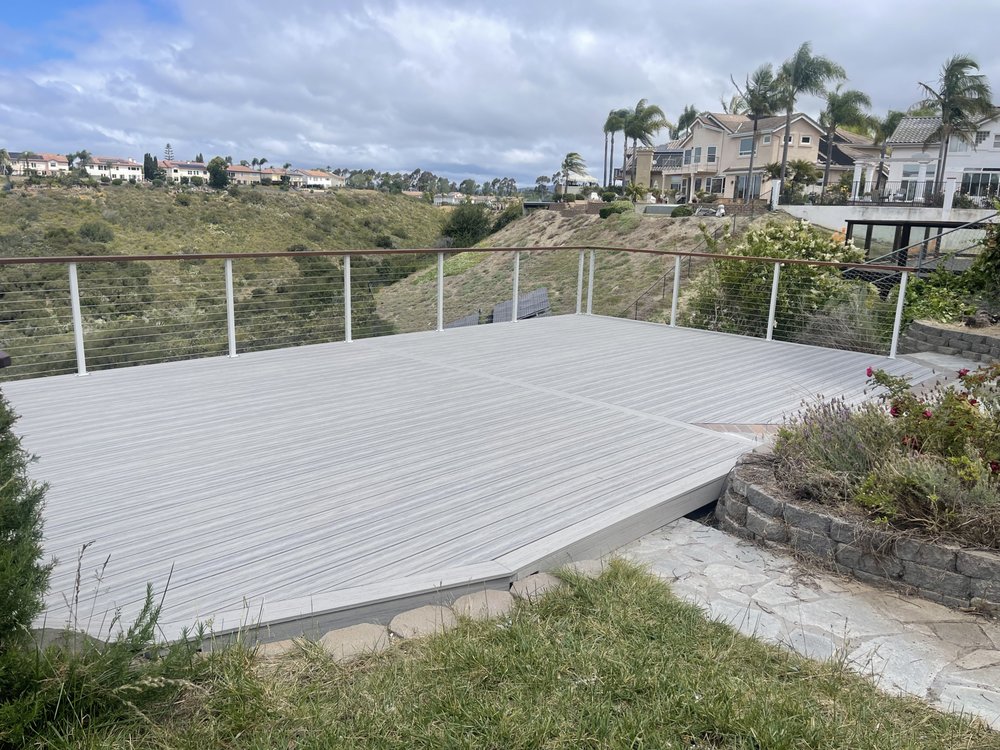
A coastal deck in San Diego mostly fights salt and moisture, while an inland deck mostly fights heat, UV and big daily temperature swings. The frame can look identical on paper, but the fasteners, board color, finish schedule and even the permit path should change with your distance from the water.
Plenty of decks fail early because they were specified for the wrong side of the county. A spec that is perfect in Santee can corrode quietly in Ocean Beach, and a board that stays comfortable in Coronado can scorch bare feet in El Cajon. Here is what changes, area by area, and why.
One County, Several Climates
San Diego is often described as having one mild climate. For a deck, it has at least four. The marine layer, the sun and the distance from salt water shift a lot between the beach and the foothills.
| Zone | Example areas | Main stress on a deck |
|---|---|---|
| Coastal strip | La Jolla, Pacific Beach, Ocean Beach, Point Loma, Coronado, Imperial Beach, Del Mar | Salt in the air, damp mornings, slow drying |
| Coastal mesas | Clairemont, Mira Mesa, Carmel Valley, University City | Some marine moisture, more sun, canyon slopes |
| Inland valleys | El Cajon, Santee, Escondido, Poway, Lakeside | Strong UV, summer heat, wide day-to-night swings |
| Foothills and backcountry | Ramona, Alpine, Julian, Jamul | Heat, wildfire exposure, occasional frost at elevation |
The lines are fuzzy. A canyon home in Point Loma can catch fog for half the morning, while a ridge home a mile away sits in full sun. Your deck's real exposure depends on the lot, so treat the table as a starting point and look at your own yard on a June morning and an August afternoon.
What Salt Air Does to Decks Near the Ocean
Salt rarely attacks the boards first. It goes after the metal. Joist hangers, post bases, screws, nails and ledger bolts all corrode faster when chloride-laden air settles on them, and most of that metal sits under the deck where nobody looks.
The failure pattern is easy to miss. The surface looks fine for years while hanger nails thin out and connectors lose their grip. By the time a board feels bouncy, the hardware underneath may be the actual problem.
That is why salt air decking is mostly a hardware decision. Connector makers publish corrosion guides that define a seaside exposure zone and recommend heavier coatings or stainless steel inside it. The Simpson Strong-Tie corrosion guidance is a common reference here. Within reach of the ocean, Type 316 stainless is the safest choice for fasteners and connectors, because its molybdenum content resists chloride pitting better than Type 304.
Never mix metals on a coastal deck. A stainless screw driven through a galvanized hanger sets up galvanic corrosion at the contact point. Match the fastener to the connector, and match both to the exposure.
Marine Layer Deck Damage: The Moisture Problem
The marine layer that blankets the coast from late spring into summer (the stretch locals call May Gray and June Gloom) keeps decks damp for hours. Wood that stays wet longer absorbs more water at the end grain, which is where checking and rot start.
On composite and PVC, moisture shows up differently. Shaded, north-facing decks near the water are prone to mildew spotting on the surface, especially where leaves and pollen collect in the gaps. It cleans off, but it comes back if the deck never gets sun.
The ledger is the other weak spot. Fog-driven moisture plus wind-blown rain finds any gap in the ledger flashing. When a coastal deck fails at the house connection, poor flashing is a common reason, and the damage often reaches the rim joist of the house itself.
Inland Decks: Heat, UV and Movement
Move east past Interstate 15 and the problems flip. Summer afternoons in El Cajon or Santee often run 20 degrees or more above the beach, and the sun is stronger with no marine layer to soften it.
Wood decks inland gray and check faster because UV breaks down the surface fibers and repeated heating dries the wood out. Stain that lasts three years in Del Mar may look tired after two in Ramona.
Composite and PVC boards absorb heat too. Dark boards in full afternoon sun can get uncomfortably hot underfoot, so lighter colors and heat-mitigating product lines matter more inland. Plastics also expand and contract with temperature, which means gap spacing and fastener choice have to follow the manufacturer's instructions to the letter. Many inland neighborhoods also sit in mapped fire hazard zones, which can limit decking choices. Our post on San Diego fire zone deck requirements covers that side.
Airflow and Drainage Under the Deck
On both sides of the county, what happens under the deck decides how long the frame lasts. A deck that can breathe dries out after fog or irrigation. A deck boxed in with solid skirting and no vents holds moisture against the joists for days.
Near the coast, leave open space or vented skirting so ocean air can move through, and slope the ground underneath away from the house. Inland, the bigger moisture source is usually sprinklers. Aim irrigation heads away from posts and the ledger, and keep planter boxes from sitting directly on the deck boards where water pools underneath.
Low decks are the hardest case everywhere. With little room below, airflow drops and debris piles up. For decks less than a foot or so above grade, a moisture-tolerant board, joist tape on the framing and a gravel base under the deck all help.
Material Choices by Zone
No board is wrong everywhere, but some are a better match for one side of the county than the other.
| Material | Coastal | Inland | Watch out for |
|---|---|---|---|
| PVC (such as AZEK) | Excellent, no wood fiber to absorb moisture | Good, pick lighter or cooler lines | More thermal expansion than composite |
| Capped composite | Very good | Very good | Dark colors run hot; mildew in shade |
| Redwood or cedar | Fair, needs frequent sealing | Fair, grays fast in sun | Finish every 2 to 3 years |
| Pressure-treated | Fair for framing, weak as a surface | Fair | Checking, warping, needs coated hardware |
| IPE hardwood | Very good | Very good | Weight, cost, oiling to keep color |
| Aluminum | Very good with proper coating | Very good, noncombustible | Look, price, can feel warm in sun |
For the longer version, including warranties and costs, see our guide to the best decking material for San Diego.
Same Deck, Two Addresses
Picture a 12-by-16 attached deck, three feet off the ground, built twice: once in Pacific Beach, six blocks from the sand, and once in a Santee backyard.
In Pacific Beach, the plan would call for stainless or the heaviest-coated connectors, a stainless fastener schedule, a fully flashed ledger with a drip edge, and PVC or a mid-tone capped composite. The permit check would include whether the parcel sits inside the coastal zone.
In Santee, the frame and footings would look about the same, but hot-dip galvanized hardware rated for treated lumber is typically enough. The board choice would lean toward a light, heat-resistant color, and the plan would confirm the fire hazard zone before anyone ordered decking.
Same size, same height, same basic frame. Different hardware, different boards, different paperwork.
Upkeep: What Changes After It's Built
- Rinse schedule: coastal decks benefit from a fresh-water rinse every two to three months to wash salt off hardware and boards. Inland, once or twice a year is usually plenty.
- Hardware checks: coastal decks deserve a look underneath around year three, then every couple of years. Inland decks can usually wait longer.
- Wood finish: roughly 18 to 24 months near the coast, and often two to three years inland, depending on sun exposure.
- Composite and PVC: soap, water and a soft brush in both zones, with more attention to mildew on shaded coastal decks.
These are practical intervals from experience, not code requirements. A south-facing deck in full sun or a deck under a dripping tree will set its own pace.
Planning Differences Before You Build
Near the water, the first question is jurisdiction. Many coastal parcels from La Jolla to Coronado sit inside the California coastal zone, which can add a coastal development permit on top of the building permit. Our guide to the coastal commission deck permit walks through how that works in La Jolla, Del Mar and Coronado.
Inland, slope and soil come first. Canyon lots often need taller posts and engineered footings, and some inland areas have expansive clay soils that move as they wet and dry. Fire hazard mapping can also shape what decking you are allowed to use within 10 feet of the house.
If you want someone to read your site before you pick materials, a San Diego deck builder who works on both sides of the county can tell you which list applies to your lot in one visit.
What Doesn't Work
A few shortcuts show up again and again on failed decks.
- Painting over rusted joist hangers. The paint hides the corrosion and does nothing to stop it.
- Assuming composite means zero care near the beach. The boards hold up well, but the frame and hardware beneath them still need attention.
- Choosing the darkest board inland for looks alone, then avoiding the deck every summer afternoon.
- Copying a neighbor's spec without checking whether their deck faces the same sun, wind and fog.
The ocean decides most of what a coastal deck needs, so build for the air your deck actually breathes.
Quick Answers
How close to the ocean counts as a coastal deck in San Diego?
There is no single cutoff. Connector manufacturers define their own seaside exposure zones, and fog and wind can carry salt well inland on some lots. Within roughly a mile of the water, treat the deck as coastal and use stainless or heavily coated hardware.
What decking is best near the ocean?
PVC decking such as AZEK holds up best to salt air because it contains no wood fiber. Capped composite also performs well. Whatever the boards, pair them with Type 316 stainless fasteners and matching connectors.
Does the marine layer damage decks?
It can. The marine layer keeps decks damp for hours, which speeds up checking and rot in wood and encourages mildew on shaded composite. Good ledger flashing, airflow under the deck and regular cleaning keep it in check.
Do inland San Diego decks need different materials?
Often, yes. Inland decks face more heat and UV, so lighter or heat-mitigating boards, UV-stable finishes and correct expansion gaps matter more. Fire hazard zones inland can also limit which decking is allowed near the house.
Tell us your address and we will spec the hardware, boards and finish for your actual site.
Get a Free Estimate