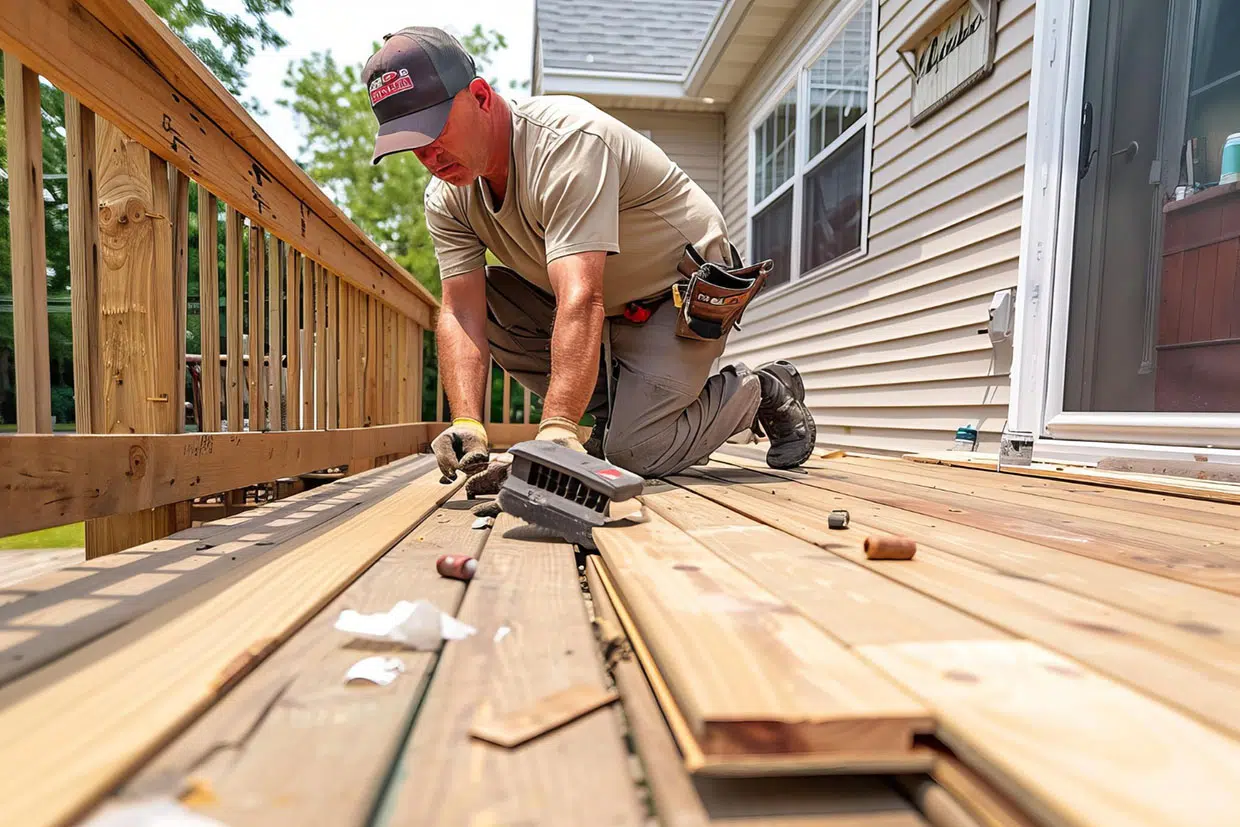
A deck that has been fine for six years with four people on it has never actually been tested.
Howl-O-Scream runs select nights from 11 September to 31 October 2026, and party season runs from there straight through New Year. This is the stretch when San Diego backyards carry a crowd instead of a couple of people, and it is when problems that have been quietly developing for years get found the hard way.
Four People and Twenty People Are Different Load Cases
Residential decks are designed for 40 pounds per square foot of live load plus 10 pounds of dead load. On a 12 by 16 foot deck — 192 square feet — that is 7,680 pounds of live capacity on paper. Twenty guests at an average 180 pounds is 3,600 pounds, comfortably inside the design number.
So the design is rarely the problem. Two other things are.
Distribution. Nobody spreads evenly. Everyone crowds the rail when something is happening, which puts most of that 3,600 pounds on one bay or a cantilevered edge that was never sized for it.
Condition. A deck with a rotted post base, a corroded ledger bolt or a footing that has settled is no longer carrying its design load, regardless of what the original drawings said. The load rating describes a deck in the condition it was built in, not the condition it is in now.
The walkthrough below takes about thirty minutes and finds nearly everything that matters.
The Walkthrough
Boards and soft spots
Walk every board, including the ones under furniture that never get stepped on. Bounce at mid-span between joists and note anything that flexes noticeably more than its neighbors.
Then probe. Push a screwdriver into the board at any suspect point with hand pressure. If the blade sinks a quarter inch, that is rot, not weathering. Concentrate on the areas where water sits: where the deck meets the house, around post bases, under planters, and at board ends.
The railing wobble test
Grab the top rail at mid-span between two posts and push outward hard with your body weight. The code requirement is a 200-pound concentrated load applied at any point along the guard, so a shove from an adult should produce essentially nothing.
Any visible movement at the post base is a failure. Test every post individually — railings fail one post at a time, and the loose one is rarely the one you would have guessed.
Guard height and baluster spacing
Two measurements, both from the deck surface:
- Guard height: 42 inches in California on any deck more than 30 inches above grade
- Baluster spacing: a 4-inch sphere must not pass through any opening in the guard, including the gap at the bottom rail
Older decks built to a 36-inch standard, or decks where the surface was resurfaced with a second layer of boards over the original (which quietly lowers the effective guard height), fail this routinely.
Ledger and flashing
This is the connection that matters most, and it is checked from below and from the side of the house rather than from the deck.
Look for water staining or discoloration on the siding directly beneath the ledger line, rust streaks running down from bolt heads, flashing that has lifted or separated at the top edge, and any sign of the deck pulling away from the house at the ends.
Then look at what is actually holding it on. If you see nails and no bolts or structural screws, stop the inspection and call someone. That is the single most common cause of deck collapse and it is not something to sit with through a party season.
Footings and post bases
Probe the base of every post with a screwdriver, on all four faces. Check whether posts bear directly on concrete or sit on a standoff base — direct bearing wicks water and rots from the contact face upward, invisibly.
Then look for movement: gaps that have opened between post and beam, posts out of plumb, footings that have settled or heaved, and cracked or spalling concrete around a post base.
Stairs
Stairs are the most-used and least-inspected part of a deck.
- Riser consistency: no more than 3/8 inch difference between the tallest and shortest riser in a single flight. Inconsistent rise is what actually causes falls.
- Rise and run: maximum 7 3/4 inch rise, minimum 10 inch tread depth.
- Handrail: 34 to 38 inches above the nosing line, graspable, and continuous for the full run.
- Stringers: check the attachment at both the top and bottom. The bottom connection is often sitting in dirt or on a slab where it has been absorbing water for a decade.
What You Can Fix and What Needs a Contractor
Reasonable to handle yourself: replacing a few surface boards, tightening railing hardware and lag bolts, resetting a loose stair tread nosing, clearing debris from between boards so water drains.
Call someone for any of these findings, without exception:
- Anything wrong at the ledger, including nails-only attachment
- Any rot at a post base or in a post
- Any footing that has moved or settled
- Railing that moves at the post under a firm push
- Guard height under 42 inches or spacing over 4 inches
- More than two or three soft boards, which usually indicates a drainage problem rather than a board problem
Most of these are a two-to-five day deck repair rather than a project. If the list runs long enough that you are wondering whether the deck is worth fixing at all, that calculation is worked through in repair or replace your deck.
If the structure is an elevated balcony on a multi-family building, a self-inspection does not satisfy the state requirement — SB326 mandates an inspection by a licensed professional on a set cycle. See deck inspection.
Lighting Is a Safety Item at a Party
Crowds move around a deck after dark, and stairs are where the injuries happen. Riser lights on every step and post-cap or rail lighting at the perimeter change the risk profile of an evening party more than anything else you can add. Options and fixture types are covered on the deck lighting page.
Book It in September, Not Late October
Repair scheduling in San Diego follows a predictable curve. In September crews have availability, the weather is dry, and a typical repair list closes out in two to five days.
By late October three things happen at once: everyone who is hosting calls in the same two weeks, the first rain arrives, and any staining or sealing work needs 24 to 48 hours of dry weather to cure properly. If you want the deck sorted before Thanksgiving, the call happens now rather than after you find something.
More San Diego Deck Updates
Seasonal notes, permit changes and build-window timing all live on the San Diego deck updates hub.