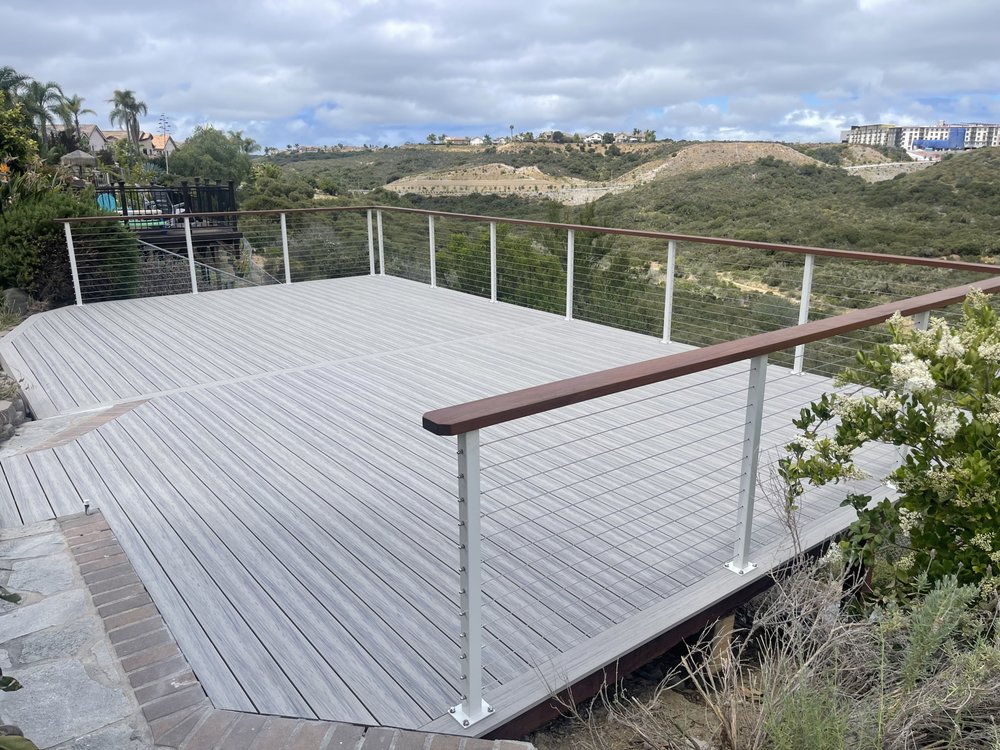
The decking still looks fine at year eight while the hardware holding it to the house has lost a third of its section.
The La Jolla Art & Wine Festival runs 10 to 11 October 2026 on Girard Avenue. Half a mile from that street, decks built in the same year are failing at wildly different rates, and the variable is almost never the decking.
Salt Air Does Not Start With the Decking
Chloride from marine air deposits on every surface of a deck, including the ones nobody looks at. On the decking boards it does very little — it fades, it greys, it stains, and it stays structurally irrelevant. On steel it strips the protective zinc layer, then works on the base metal underneath.
That produces the failure pattern we see repeatedly on the coast: a deck whose surface looks presentable at year eight, sitting on connectors that have lost meaningful cross-section. Nobody replaces a deck because the boards look tired. They replace it because the hardware went and the frame is no longer trustworthy.
Which means everything below matters more than what you pick for the walking surface.
Stainless vs. Hot-Dip Galvanized, and Where Each Belongs
Two things drive the specification. The first is proximity to open surf. Connector manufacturers generally call for stainless steel within roughly half a mile of breaking surf, because that is where airborne chloride concentration stops being an academic concern. The second is the lumber itself: modern pressure-treated wood uses copper-based preservatives (ACQ, copper azole) that are aggressive toward zinc, so light galvanizing corrodes from both sides.
The grades that matter:
- G90 galvanized — inland only. It does not belong within sight of the water.
- G185 / ZMAX hot-dip galvanized — the minimum for treated lumber anywhere in San Diego County.
- Type 304 stainless — acceptable a few miles inland, marginal on the coast.
- Type 316 stainless — contains molybdenum, which is what resists chloride pitting. This is the coastal grade.
Where each belongs on a La Jolla or Sunset Cliffs deck:
| Component | Coastal specification |
|---|---|
| Ledger bolts and ledger flashing | 316 stainless, no exceptions |
| Joist hangers | 316 stainless within half a mile of surf; G185 minimum beyond |
| Post bases and hold-downs | 316 stainless, or G185 with a standoff base |
| Deck board fasteners | 305 or 316 stainless |
Two things never to use on the coast: electro-galvanized hardware of any kind, and aluminum flashing against treated lumber, which sets up a galvanic cell and eats the flashing.
Stainless hardware runs three to four times the cost of galvanized. On a whole-deck budget it is a small line item, and it is the only line item you cannot revisit later without dismantling the deck to reach it.
The Ledger Is the Connection That Matters
The ledger board is where the deck attaches to the house, and it carries roughly half the deck’s total load into the building. It is also the connection involved in nearly every deck collapse on record, and it is the hardest thing on the deck to inspect because it sits behind flashing and trim.
Salt-laden moisture gets behind poorly detailed flashing, sits in the joint between ledger and sheathing, and works on the bolts from a position where you cannot see it. Done correctly, the connection uses stainless or copper flashing, 316 stainless through-bolts or structural screws in a staggered pattern, and a drainage gap so water never stands in the joint. Done incorrectly — nails instead of bolts, aluminum flashing, no gap — a coastal ledger can be compromised in under fifteen years.
If your deck is an elevated balcony on a multi-family building, this connection is also what SB326 inspections are specifically written to examine. That is a separate legal requirement with its own timeline, covered on our deck inspection page.
Hangers, Post Bases and the Hardware You Cannot See
Learn to read two colors on galvanized steel. White powder is zinc oxidizing, which is the coating doing its job — not an emergency. Red-brown streaking below a hanger or running down a post is base steel exposed, and from that point the clock is running.
On joist hangers, check that every nail hole is filled and that the fasteners are actual structural connector nails, not whatever was in the truck. A hanger missing a third of its nails carries a fraction of its rated load, and salt corrosion on the remainder accelerates the rest.
On post bases, the detail that separates a 15-year deck from a 30-year deck is a standoff base that holds the post about an inch above the concrete. A post bearing directly on a slab wicks moisture continuously, and in a coastal yard that rots from the bottom up well inside ten years — usually invisibly, because the rot starts at the contact face.
Coastal Maintenance Intervals vs. Inland
The same deck built in La Jolla and in Poway is on two different schedules:
| Task | Coastal (La Jolla, Sunset Cliffs, Coronado) | Inland (Poway, Escondido, El Cajon) |
|---|---|---|
| Freshwater rinse | Every 2 to 3 months | Once or twice a year |
| Surface recoat or seal | 18 to 24 months | 3 to 4 years |
| Hardware inspection | Year 3, then every 2 years | Year 5, then every 3 to 4 years |
| Full structural inspection | Every 5 years | Every 7 to 10 years |
The freshwater rinse is the highest-value item on that list and it costs nothing. Rinsing chloride off the frame and hardware with a hose before it concentrates does more for a coastal deck’s lifespan than any product you can buy.
Surface sealing and coating is a separate discipline with its own schedule — see deck waterproofing for what that involves and when it is due.
What to Inspect at Year 3
Take a flashlight and get underneath. You are looking for the start of things, not failures:
- Rust streaking on or below any joist hanger
- Missing or backing-out hanger nails
- Discoloration or water staining on the siding directly below the ledger line
- Any post sitting flat on concrete with no standoff
- Bolt heads at the ledger showing red rust rather than white powder
- Flashing that has lifted, curled or separated at the top edge
What Changes at Year 5
At year five the inspection gets more invasive because surface indicators are no longer sufficient. Lift one or two decking boards adjacent to the ledger to see the top of the ledger and the flashing lap directly. Probe the base of every post with a screwdriver — if the blade sinks a quarter inch under hand pressure, that is rot, not weathering. Check for movement at the beam-to-post connection by pushing hard at the beam.
This is also the decision point on hardware. Replacing corroded connectors at year five is a repair. Discovering them at year twelve is usually a rebuild.
Where This Hits Hardest in San Diego
La Jolla and Sunset Cliffs are the worst exposure on this list — direct onshore spray with nothing between the water and the structure. Point Loma and Coronado sit close behind, with Coronado exposed on three sides. Pacific Beach and Del Mar are meaningfully lower but still well inside the range where stainless is the right call.
Move five miles inland and the calculus changes completely. Mission Valley, La Mesa and Poway decks live on the inland schedule and G185 hardware serves them well.
Composite Does Not Solve This
Worth saying plainly: switching to composite decking eliminates surface maintenance, not corrosion. The frame is still lumber, the connectors are still steel, and the ledger connection is unchanged. A composite deck on undersized coastal hardware fails the same way a wood one does, just with a better-looking surface on top of it. See composite decking for what it does and does not buy you.
More San Diego Deck Updates
Seasonal notes, permit changes and build-window timing all live on the San Diego deck updates hub.